Clara AI Assistant Guide for Dev Agencies
Learn what Clara AI assistant is, how it ranks sources, and how software development agencies can get cited by AI to win pipeline.
A search for “Clara AI assistant” lands in a crowded naming system that spans scheduling, customer support, finance, research, and other assistant products. For a software development agency, that makes Clara a discovery surface rather than a software review target. If an AI assistant cites the wrong company, product, or category when buyers compare vendors, your content budget is working against you.
What Clara AI Assistant Actually Is
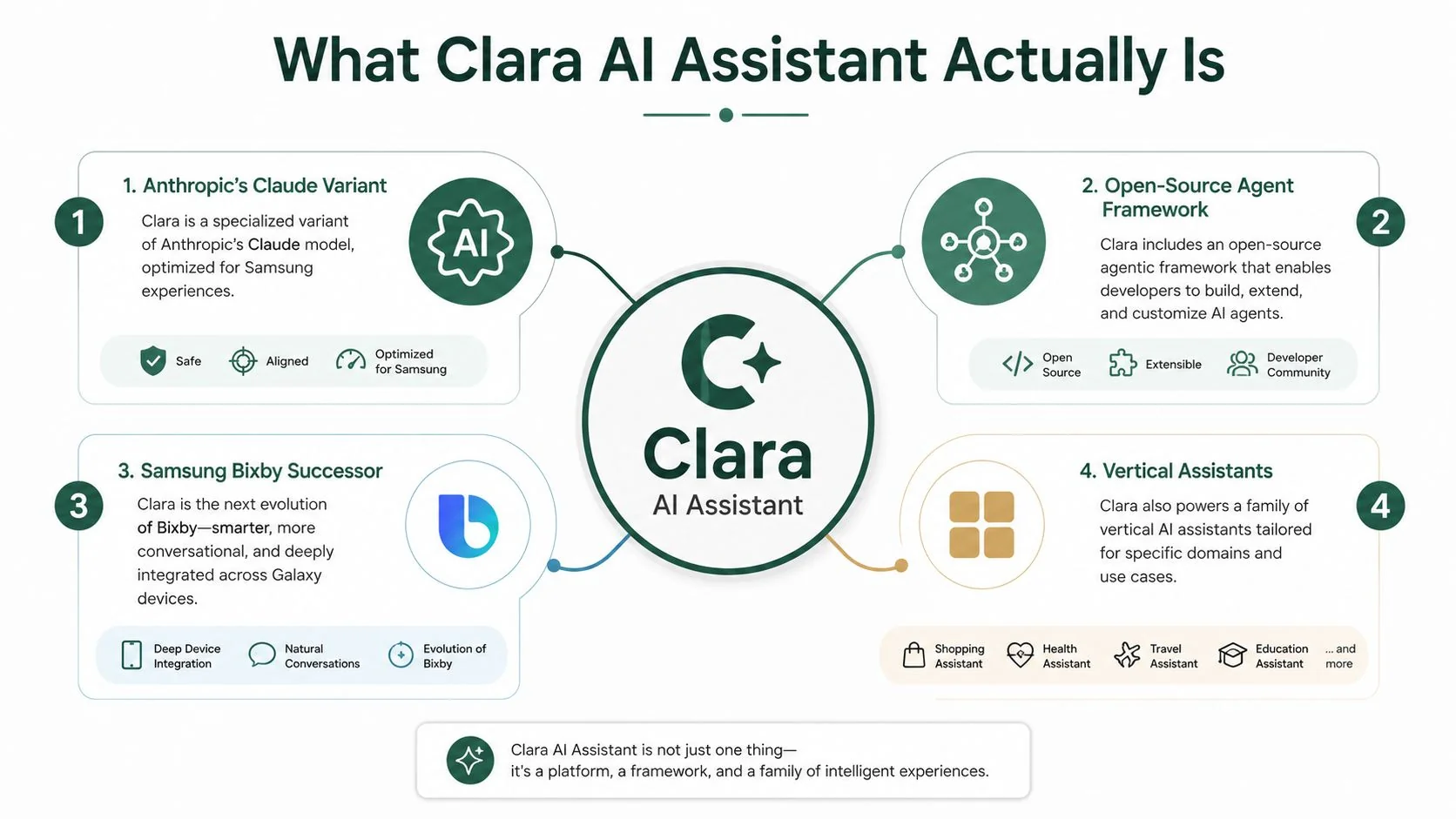
Clara AI assistant is an umbrella term, not a single universally defined platform. Search results can point to an email scheduling assistant, a multilingual SME chatbot, a financial research tool, a medical AI product, or another assistant using the Clara name. NVIDIA, for example, uses Clara for a medical AI family that includes imaging and reasoning tools, while Clara Labs refers to an email-first scheduling product.
That distinction matters because a founder comparing development partners may ask an assistant which agency builds a particular stack, serves a particular vertical, or can handle a defined project type. The assistant compresses several research steps into one answer, then attaches sources to support the recommendation. The citation graph moves upstream of the sales call.
A Clara-style assistant combines retrieval, conversational synthesis, and citation rendering. It may retrieve passages from indexed pages, compare entities with similar names, and assemble a response that looks definitive even when the source set is mixed. That makes product identity, page structure, and corroboration commercial concerns as well as technical SEO ones.
Practical rule: Treat Clara as a place where buyers form a shortlist, not as a chatbot you need to review.
For a dev agency, the move is straightforward. First identify which Clara product a query means. Then identify which buyer question the assistant is answering. Finally, publish a source that gives the assistant a clean, attributable answer about your niche, capabilities, and proof.
An agency building this layer may also study a unified AI chat platform to understand how multiple assistant experiences can be organized around one knowledge base. The relevant lesson is whether the underlying content has clear entities, narrow topics, and evidence that a retrieval system can reuse.
The Four Clara Products Buyers Confuse
Four different categories sit behind that one phrase. The first is an Anthropic Claude enterprise assistant, often reached through a typing error or informal shorthand. The second is an open-source Clara agent framework on GitHub. The third is a Samsung Bixby successor rumored or described under the Clara name. The fourth is a group of vertical assistants embedded in scheduling, CRM, finance, research, and support workflows.
These products have different vendors, deployment models, users, and data policies. A scheduling assistant may work through email and calendars. A customer-support assistant may price usage by conversations. A research tool may keep data in a user-controlled database. Treating them as one product creates bad comparisons and sends agency content toward the wrong retrieval surface.
| Product | Vendor | Deployment | Primary User | Citation Behavior | Dev Agency Relevance |
|---|---|---|---|---|---|
| Claude enterprise assistant, sometimes mistyped as Clara | Anthropic | Hosted enterprise AI | Business teams and technical users | Stronger when the question names a clear entity or capability | High for technical vendor research |
| Clara agent framework | Open-source community | Self-managed or developer-hosted | Engineers building agents | Depends on repository documentation and linked references | High for implementation-focused searches |
| Clara, described as a Samsung Bixby successor | Samsung-related naming in search discussion | Device-integrated assistant | Consumer device users | Product and device documentation dominate | Low unless the agency serves device ecosystems |
| Vertical Clara assistants | Different commercial vendors | SaaS, API, email, or embedded workflow | Operations and support teams | Pricing, integration, and product pages supply the evidence | Medium to high for automation buyers |
The product history makes the fourth category especially important. Clara Labs was founded in 2014, attracted hundreds of corporate clients during its year-long beta, announced a $7 million Series A in 2017, and was acquired by TopFunnel in 2019, with CB Insights listing total funding at $12.63 million. Those milestones place it among earlier commercial assistants focused on email and calendar automation, not among the other Clara-named systems.
The problem for an agency is simple: misidentification wastes content budget. Don’t publish a generic “Clara AI review” and expect it to create authority for a React Native, fintech, or healthcare development niche. Build pages that disambiguate the product family, then answer the buyer’s actual vendor question.
Use observed query logs and recorded prompt tests to see which product your buyers actually mean when they search for it.
How Clara-Style Assistants Source and Rank Information
A retrieval assistant usually starts by crawling or indexing available material. It then rewrites the user’s question into search-friendly subqueries, retrieves passages through a combination of semantic vector matching and lexical BM25 matching, reranks the candidates, grounds the response in selected text, and attaches citations.
That sequence creates several opportunities for agency content to win or disappear. A page can mention “fintech app development” but still lose if the surrounding content gives no clear service definition, no named author, no project evidence, and no corroboration from trusted external pages. Retrieval systems need enough context to decide whether the page describes a real capability or merely repeats a keyword.
The signals that make a page reusable
Topical authority helps an assistant connect an agency with a specific entity and service. Freshness can matter for changing technologies and commercial details, but a recent page with weak evidence shouldn’t outrank a well-supported niche page only because it has a newer date. Structured data helps machines parse organization identity, services, breadcrumbs, and authorship. External corroboration gives the assistant more than one place to verify the claim.
Answer format also matters. A buyer asking for a definition needs a concise definition. A buyer asking for alternatives needs a comparison. A buyer asking which agency serves a niche needs a list with explicit reasons and sourceable proof.
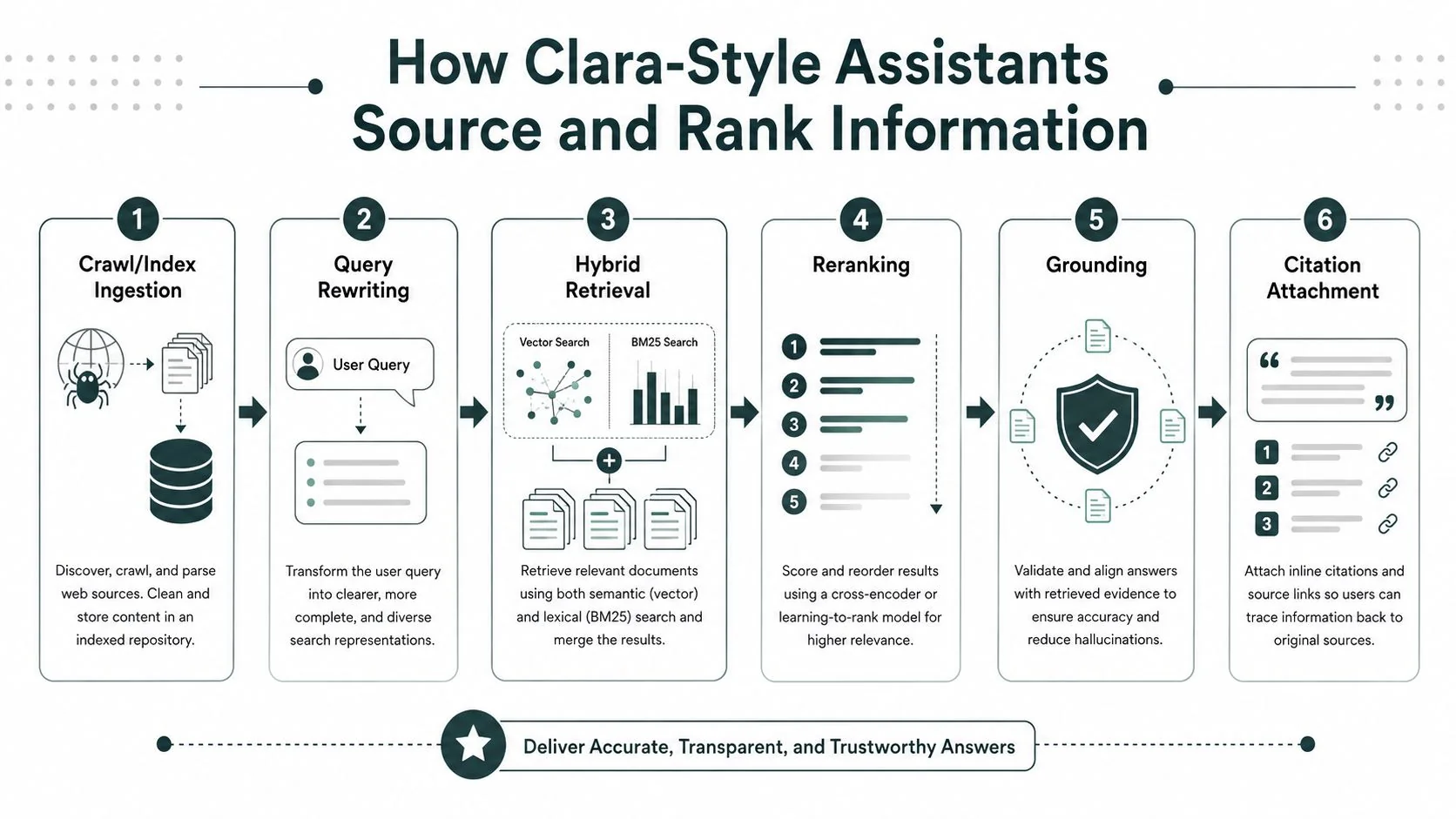
The practical conclusion is to publish concise answer blocks, then provide deeper evidence below them.
For a dev agency, a citation-shaped asset beats a broad blog post. Create a direct service definition, a comparison page, a proof page, and a technical capability page. Each should answer one buying question cleanly enough for an assistant to quote without reconstructing your positioning from scattered paragraphs.
Clara vs ChatGPT vs Claude vs Perplexity on Citations
No assistant should receive the same content strategy. Each one exposes and weights evidence differently, so agencies need a priority order instead of a vague “optimize for AI” program.
Clara-style assistants tend to perform best when the source has a clear entity, a narrow topic, and a structure that matches the query. Perplexity is a strong discovery target because its interface makes source selection visible and often favors current pages. ChatGPT is useful for brand recall and broad synthesis, while Gemini becomes more relevant when local search and Google’s business ecosystem influence the query.
| Assistant | Shows Sources | Prefers Fresh Content | Weights Niche Specificity | Typical Dev Agency Hit Rate |
|---|---|---|---|---|
| Clara-style assistants | Usually when retrieval supports attribution | Relevant when product or capability details change | High | Strong for clearly defined niche pages |
| Perplexity | Yes, visibly | High | Moderate to high | Strong for current comparison and discovery queries |
| ChatGPT | Varies by mode and retrieval context | Moderate | Moderate | Better when the agency has established brand mentions |
| Claude | May provide references depending on workflow | Moderate | High for technical context | Less dependable for commercial vendor discovery |
| Gemini | Varies by product and query | Often tied to Google’s information ecosystem | Moderate | More useful when local intent matters |
Treat the table as an operating model, not a measured benchmark. Run the same prompt across assistants, record the cited URLs, and make decisions from your own evidence.
Investment order: Build for Perplexity and Clara-style discovery first, strengthen ChatGPT brand recall second, and prioritize Gemini when Local Pack visibility affects your market.
Claude can also decline or redirect some commercial queries. That means an agency shouldn’t depend on Claude alone for buyer discovery, even if its technical audience overlaps with engineering decision-makers.
Paid acquisition needs a separate workflow. If the team is testing search demand while building citation authority, an AI ads tool for agencies can help organize that work. Keep paid testing separate from organic evidence. Ads can create attention, but they don’t replace third-party proof or clear entity ownership.
Content Signals That Get a Dev Agency Cited by AI
A dev agency becomes citeable when it publishes evidence in forms an assistant can extract. Four signals deserve priority because they map directly to buyer questions.
One page that defines the service
Put the answer above the fold. State who you serve, what you build, which stack you use, and what business outcome you support. Keep the opening definition under 120 words if that produces a cleaner answer, but don’t treat the word count as a ranking law. Use one descriptive H1, Service schema, and internal links from relevant solution pages.
A page titled “React Native Development for Fintech Companies” is stronger than “Digital Innovation Services.” The first identifies the technology, vertical, and buyer context. The second forces the assistant to infer all three.
Original data with a visible method
Opinion is difficult to cite. Original data is easier when the page names the methodology, sample, date, and limitations. Don’t publish a statistic unless a buyer can understand where it came from and whether it applies to their situation.
Use a simple rule: publish fewer claims and document them better. Add Article schema, a named author, and a dated update note.
Comparison content for active evaluation
Comparison pages answer shortlist questions. Name the alternatives, distinguish capabilities, and state where your agency fits. Pricing can be included only when it is real, current, and clearly scoped. If you don’t publish pricing, compare engagement model, project type, delivery method, and technical specialization instead.
Use a comparison-focused H1, a table, Product or Service schema where appropriate, and links no deeper than necessary from the relevant service hub.
Proof on domains buyers already recognize
Clutch reviews, GitHub repositories, named case studies, and partner pages give an assistant external material to corroborate. The proof must identify the agency, the work, the technology, and the client or project context without hiding everything behind a vague logo wall.
Publish one strong signal at a consistent cadence, then monitor actual citations rather than promising a timeline.
Structured Data and Entity SEO for AI Discovery
Structured data gives assistants a machine-readable identity layer. Start with Organization and LocalBusiness JSON-LD where applicable, then connect the agency to consistent sameAs profiles on Crunchbase, LinkedIn, and GitHub. The purpose is entity confirmation. If those profiles describe different services, locations, or names, they create ambiguity instead of authority.
Service and Product schema belong on individual offering pages. Use explicit serviceType and areaServed fields that match the language buyers use. A page for “healthcare software development” shouldn’t rely on a generic “custom software” label if the agency wants the narrower category associated with its work.
Keep visible content ahead of markup
FAQPage schema should describe answers that are visible on the page. Keep each answer concise, with 40 words or fewer as a useful editorial constraint, rather than hiding a large block of machine-targeted text. Article schema should identify a named person as the author, not only the agency brand, because attribution gives an assistant a clearer entity to associate with the material.
BreadcrumbList helps define page hierarchy. Emerging files such as llms.txt and ai.txt may become useful discovery signals, but they shouldn’t replace visible, crawlable content.
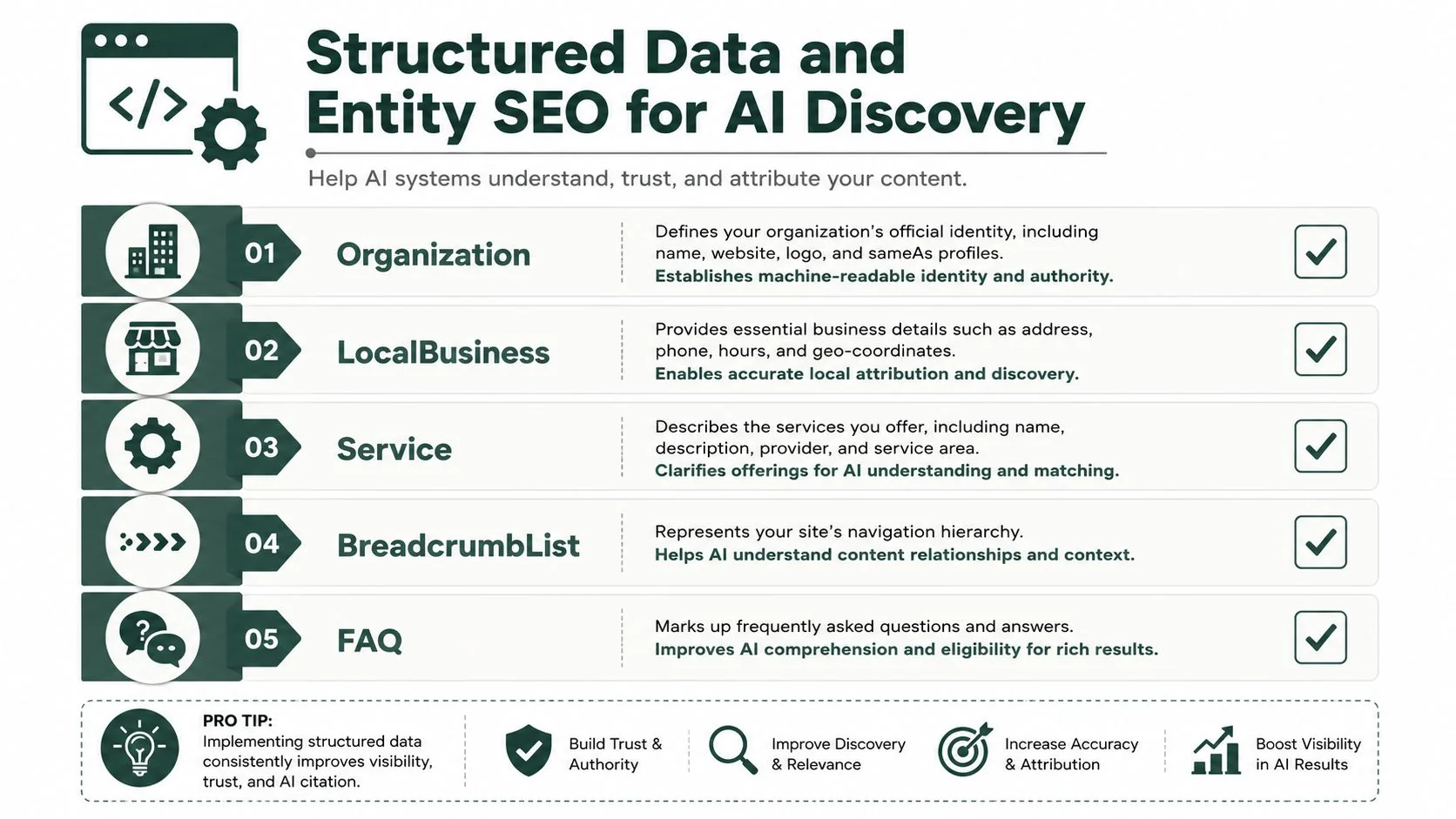
The JSON-LD types most relevant to this workflow are Organization, Service, FAQPage, Article, and BreadcrumbList. Teams looking for distribution beyond their own site can evaluate a StartupSubmit AI directory service, but directory placement should support a coherent entity profile, not compensate for an unclear website.
For agencies selecting a market before publishing, use niche validation for dev agencies to pressure-test whether the chosen category has identifiable buyers, language, and proof.
Deploy in this order:
- Validate markup: Run the pages through Google’s Rich Results Test.
- Check visibility: Confirm that every marked-up answer appears on the rendered page.
- Review entity consistency: Compare organization name, services, geography, and authorship across profiles.
- Resubmit the sitemap: Send the updated sitemap within 24 hours of deployment.
Niche Positioning and Citation Monitoring Playbook
A defensible niche has four boundaries: industry vertical, technology stack, project size, and geography. “We build software for everyone” gives an assistant no useful category to retrieve. “We build React Native fintech products for mid-market companies in a defined region” gives the system a much cleaner entity relationship.
Establish one repeated identity
Put the same noun phrases across the About page, founder bios, service pages, and projects hub. Don’t rotate between “financial technology partner,” “digital product studio,” and “custom app team” if buyers search for fintech software development. Variation is useful for readability, but the core identity must remain stable.
The projects hub should connect each project to its vertical, stack, scope, and outcome. Founder bios should explain why the agency has authority in that category. Your service page should link to the relevant projects, and each project should link back to the service definition.
Run a simple citation ledger
Test 15 buying questions each week across Perplexity and ChatGPT. Save screenshots monthly, then record four fields in a spreadsheet: prompt, assistant, cited URL, and sentiment. Add the Clara-style assistant when the product is available in your target workflow, but don’t assume one interface represents every Clara product.
Use a refresh rule before opinions enter the discussion. For example, if your tracked prompt cluster falls below a 30% citation share, review the pages answering that cluster, update stale proof, and tighten the entity language. The 30% threshold is an operating rule, not a verified industry benchmark.
The operating cadence is clear:
| Phase | Work |
|---|---|
| Week 1 to 2 | Audit existing pages, entity mentions, proof, schema, and target prompts |
| Week 3 to 6 | Publish service definitions, comparisons, proof pages, and supporting technical content |
| Week 7 to 12 | Measure citations, review sentiment, update weak pages, and remove ambiguity |
For templates and practical planning material, browse resources for dev agencies. The important part is consistency. A one-off AI visibility experiment produces anecdotes. A repeated prompt ledger produces decisions.
From AI Citations to Qualified Pipeline
Citation work matters only when it changes commercial conversations. Don’t present citation work as a pipeline forecast.
Use three observable pipeline inputs: discovery calls booked, RFP shortlists, and partnership introductions. Ask every inbound lead one qualification question, “Which AI assistant did you use to find us?” Store the answer with the cited URL in the CRM. That gives the revenue team an attribution signal that ordinary source fields miss.
| Metric | Pre-Citation Baseline | Post-Citation | Lift |
|---|---|---|---|
| Discovery calls booked | Record your current baseline | Compare after the audit period | Calculate from CRM data |
| RFP shortlists | Record current shortlist rate | Compare after citation monitoring begins | Calculate from opportunity records |
| Partnership introductions | Record current introductions | Compare after entity and proof updates | Calculate from referral notes |
The move is narrow: pick one niche, publish one pillar page, run one 30-day citation audit, and book the pipeline review. Don’t spread the effort across every assistant, vertical, and service line. Win one discovery surface first, then expand when your CRM shows that buyers recognize the category and the agency attached to it.
Book the pipeline review after your first 30-day citation audit, and bring the prompt ledger, cited URLs, sentiment notes, and CRM answers with you. If your agency needs help choosing the niche, building the pillar page, and turning AI visibility into qualified outreach, request a free positioning scan from 100Signals. The objective is specific: own one category strongly enough that buyers encounter your agency before the sales team has to explain who you are.