Cost of UiPath: What Agencies Actually Pay
Cost of UiPath explained for software agencies: licensing, infrastructure, implementation and a realistic 3-year TCO model your client can sign off on.
UiPath’s published entry point is $25 per month, but that’s the cheapest the journey gets. A functioning production program for a 100–500-person client typically clears six figures in year one and runs three to five times that over three years once implementation, infrastructure, and bot maintenance are counted.
That gap is the answer to the cost of UiPath. The subscription is only one line in a delivery budget. A serious estimate must account for licensing architecture, deployment, discovery, integration, testing, training, governance, support, consumption, and the work required when a bot stops working after an application change.
For an agency, the full cost determines whether a proposal has a defensible margin, whether a niche is commercially viable, and whether your team is selling implementation hours or owning an automation outcome.
What the Cost of UiPath Actually Covers
A $25-per-month starting price can qualify a pilot, but it cannot price a production automation estate. UiPath separates entry-level access from quote-based plans and usage-dependent components. For an agency, the commercial question is the client’s three-year delivery and operating cost, not the cheapest visible subscription.
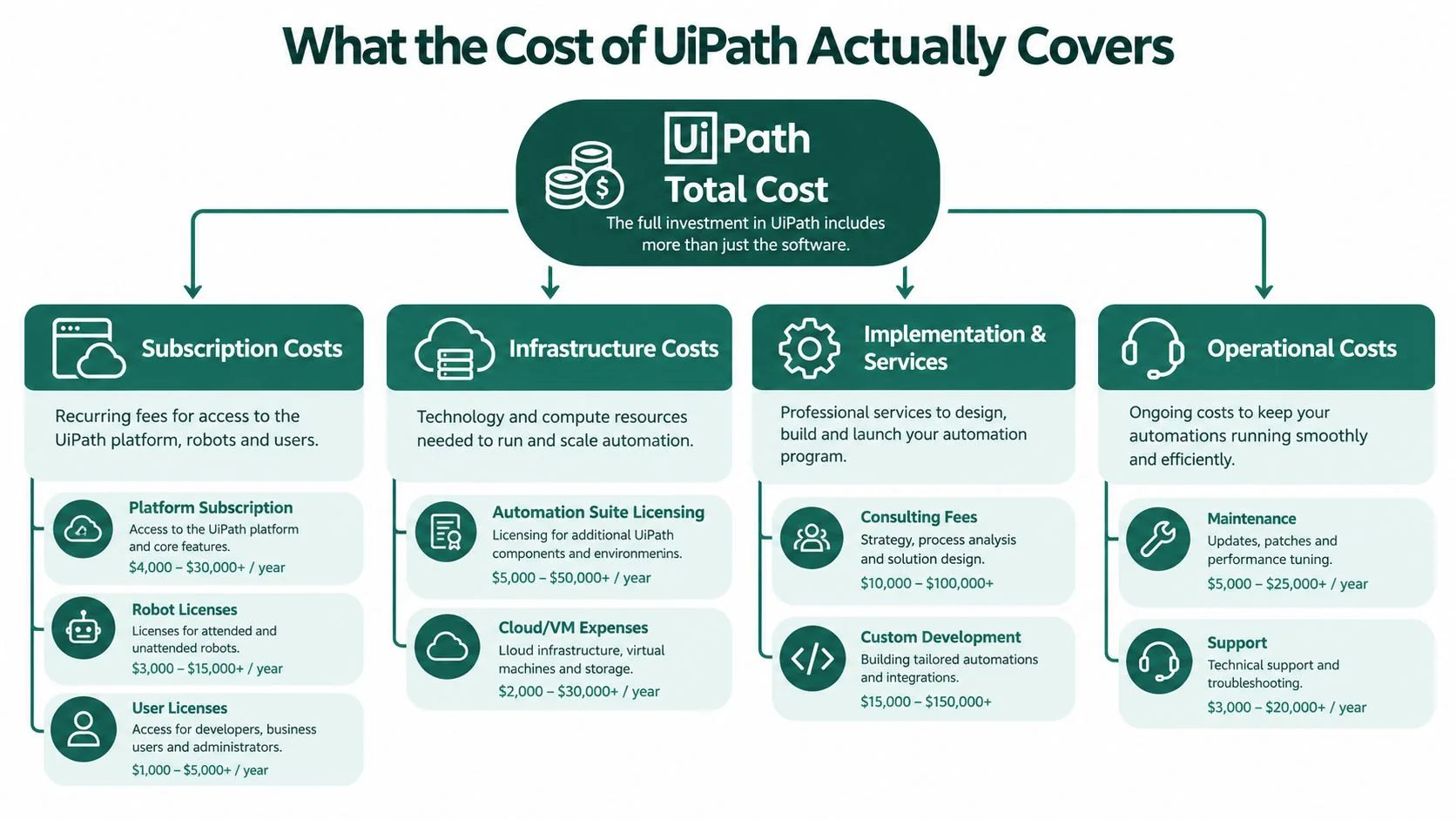
Use four cost buckets in every estimate:
| Cost bucket | What belongs in it | Why agencies must isolate it |
|---|---|---|
| Recurring licensing | Platform, robot, user, and consumption-unit licenses | Defines the software obligation across the contract |
| Infrastructure | Automation Cloud or self-hosted Automation Suite | Sets deployment overhead and operating responsibility |
| Implementation | Discovery, integration, testing, training, and rollout | Creates the initial delivery margin |
| Operations | Monitoring, bot fixes, support, governance, and AI consumption | Determines whether the account remains profitable |
The entry price is a qualification signal
A pilot may cost nothing or very little. UiPath documents a Community plan at no cost for eligible individuals and organizations. Its Basic Trial is free for internal, non-production evaluation and limited to 60 days. After the trial ends, the organization is automatically downgraded to the Free plan, according to the Automation Cloud licensing framework.
That transition should shape your sales process. A prospect requesting a proof of concept may not yet be a production buyer. State what the trial proves, what production requires, and which costs begin once the process enters a supported operating environment.
Sell a four-bucket estimate, not a robot count. Licensing defines what the client pays UiPath. Implementation defines what the client pays your agency. Infrastructure and operations determine whether your team absorbs unplanned work throughout the engagement.
Record the client’s users, execution mode, deployment constraints, document volume, and support expectations before offering a fixed price. If those inputs are missing, the estimate is not ready. Treat the resulting model as a build-versus-license decision: separate recurring platform spend from the agency work required to deliver, maintain, and support the automation over three years.
How UiPath Licensing Is Priced
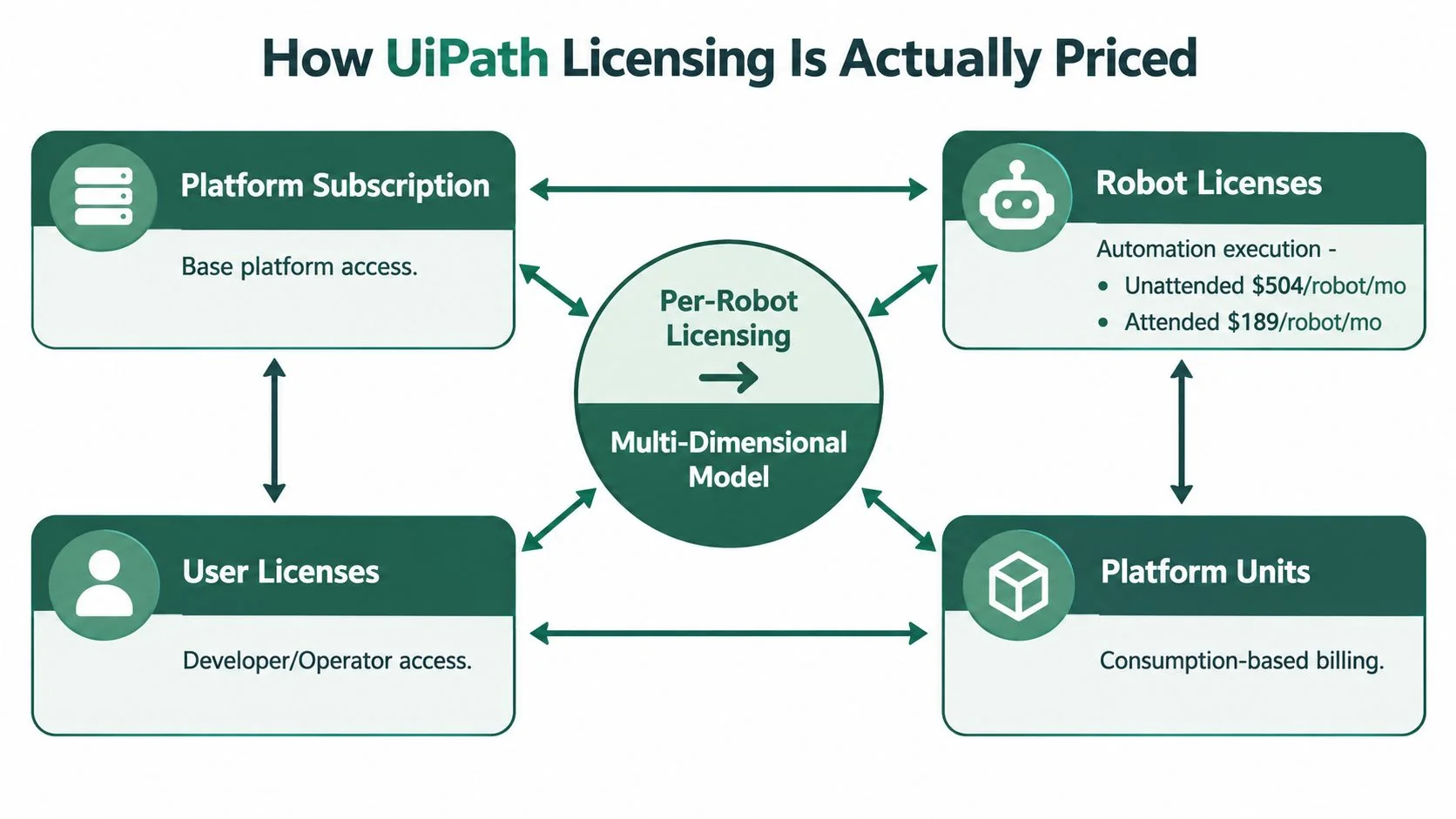
UiPath licensing is not a simple “number of bots multiplied by price” calculation. Its commercial documentation describes the Unified Pricing Plan and the Flex Plan, combining platform, robot, user, and consumption-unit licenses, as set out in the commercial licensing plans.
For an agency, that distinction affects both solution architecture and the three-year margin model. An employee running a workflow from a workstation creates a different license profile from a centralized unattended process. AI, Apps, testing, and other metered capabilities add further cost exposure. Price the operating model, not just the automation build.
Platform Units change the sizing exercise
UiPath’s licensing catalog lists a commercial SKU containing 1,000 Platform Units, with a stated minimum commitment of 150 bundles. That means the minimum bundle quantity is 150,000 Platform Units before negotiated pricing or additional components enter the discussion. The catalog also shows capabilities metered by operational scale. Inventory-management functionality, for example, can be priced per 50,000 stock-level combinations per year, with initial capacity requirements specified separately.
The process design therefore belongs in the commercial design. Before quoting, ask four questions:
| Question | Commercial consequence |
|---|---|
| How many developers build and maintain workflows? | Drives developer and platform access |
| How many employees run attended automations? | Broad deployment can increase user entitlements |
| How many unattended processes execute centrally? | Shifts cost toward robot and capacity planning |
| Which AI, Apps, testing, or document features are enabled? | Adds consumption-sensitive licensing |
Centralizing work into unattended automations can reduce end-user entitlements. Broad attended deployment increases the importance of user count. If each department receives an interactive automation, that deployment choice becomes part of the license profile and the agency’s delivery margin.
Recommendation: design the execution topology before offering a fixed implementation price. The same process can produce a different license profile based on who triggers it, where it runs, and whether jobs execute concurrently. Show recurring UiPath spend separately from implementation, maintenance, and support work in the agency’s three-year model.
UiPath also requires customers to select an environment for products managed by Orchestrator. The same product license cannot be used simultaneously across Automation Cloud, Automation Suite, and standalone Windows installations, according to the UiPath licensing policy. That choice affects architecture, procurement, security review, and support scope.
The embedded video provides additional context on the licensing model:
A proposal that only names robots leaves the agency competing on hourly rate. A proposal that maps roles, execution modes, platform capabilities, and consumption exposure gives the buyer a defendable commercial case for specialist delivery.
Where the Bill Scales With Usage
Cost does not stay fixed after the contract is signed. Usage-based exposure grows as a program adds public applications, AI-assisted work, or serverless execution. Model these drivers separately from implementation fees, because they can change the agency’s three-year margin after deployment.
A user-based robot license can register any number of robots on any machine when the same Active Directory username is present. That user cannot use multiple robots simultaneously, according to UiPath’s robot licensing documentation. Serverless Automation Cloud robots follow a different model, using robot units based on minutes of use. Your proposal should show which operating model applies to each workflow.
| Meter | What scales it | Pricing unit | Typical trigger |
|---|---|---|---|
| Named-user robot access | User identity and simultaneous use | User-based entitlement | An employee runs an attended process |
| Serverless Automation Cloud robots | Runtime duration | Robot units based on minutes of use | Queue-driven or scheduled execution |
| Public UiPath Apps | External users and deployed apps | 0.2 Platform Units per external user per app per month | A customer-facing app gains regular users |
| Autopilot | User interactions above the included grant | 300 free Platform Units per user per month, then additional units | AI-assisted work exceeds included usage |
UiPath Apps requires a user license for authenticated-app access. Public-app access consumes 0.2 Platform Units per external user per app per month, so recurring cost rises with both audience size and the number of deployed apps. A customer portal can therefore create a continuing charge even when the internal team remains the same.
Autopilot follows another usage pattern. UiPath provides each user with a monthly grant of 300 free Platform Units. Additional activity may require paid units or administrator top-ups. A contained internal pilot may stay within the included allowance, while regular AI-assisted interactions can create recurring consumption.
Model three operating states
Do not put one usage assumption into a fixed-price proposal. Build three scenarios:
- Pilot: Limited internal users, low execution volume, and no customer-facing app.
- Expected production: Normal monthly users, document volume, automation runs, and AI interactions.
- Peak production: Highest realistic app audience, runtime, document load, and concurrent demand.
This model gives a regulated or document-heavy buyer a clear connection between business volume and operating cost. It also gives your agency a defendable basis for change control, capacity planning, and margin protection across three years.
Your margin disappears when usage is treated as an implementation detail. Define who monitors consumption, who approves additional capacity, and what happens when a workflow exceeds its expected volume. Put those terms in the commercial model before the first production run.
Infrastructure and Cloud vs Self-Hosted
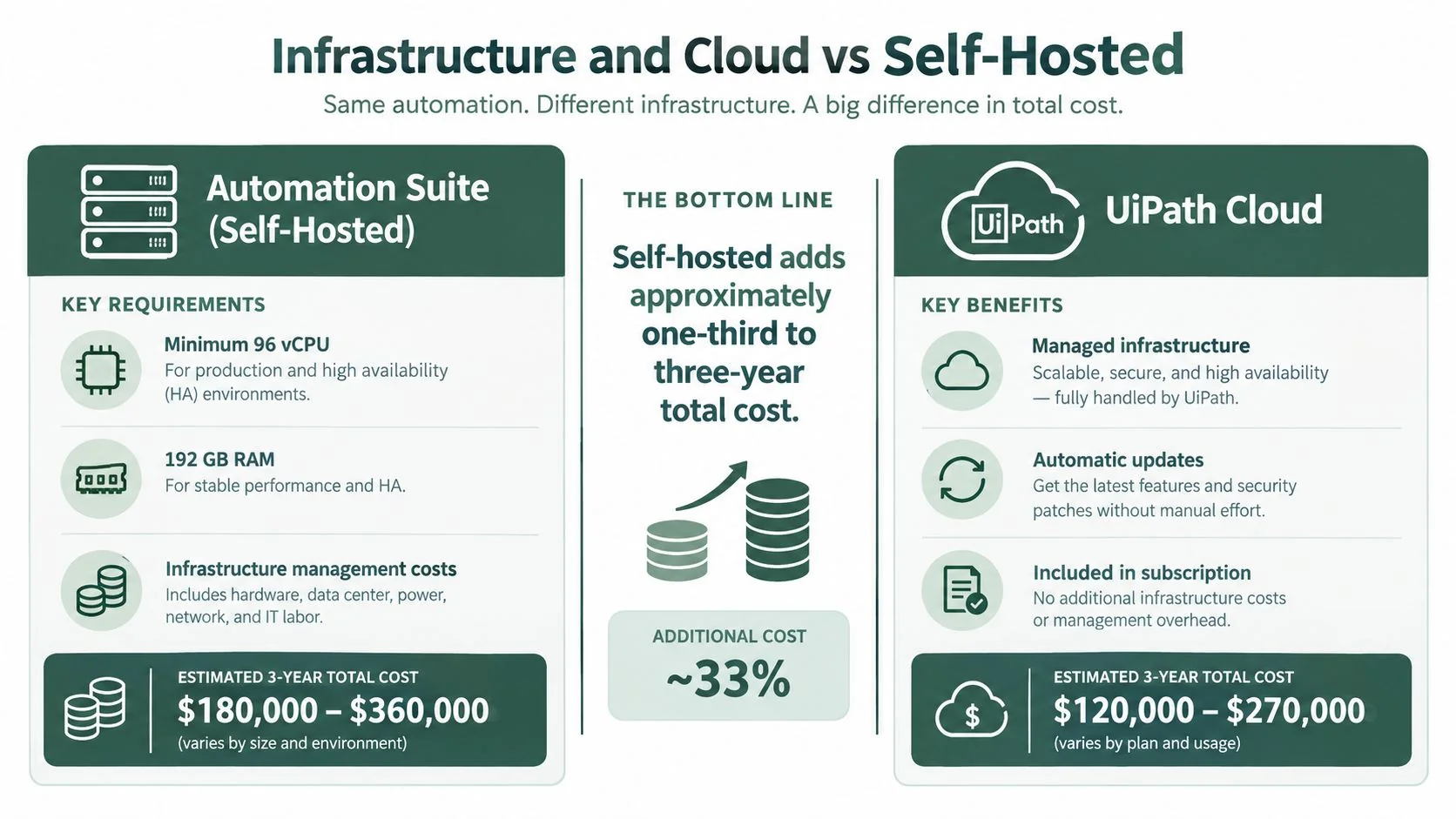
Deployment choice can determine a substantial share of UiPath’s three-year economics before software consumption is included. A self-hosted Automation Suite high-availability environment requires at least 96 vCPU and 192 GB of RAM, according to UiPath’s documented infrastructure requirements.
That figure defines the infrastructure floor, not the full operating cost. The client still needs capacity planning, security ownership, patching, monitoring, backup design, and qualified support. Your agency should price those responsibilities explicitly or state that the client owns them after handover. Use UiPath’s pricing page to frame the software discussion, then model infrastructure and delivery work separately.
Make the deployment decision with three questions
| Decision question | Automation Cloud | Self-hosted Automation Suite |
|---|---|---|
| Who manages the underlying environment? | UiPath manages the cloud platform | Client or agency manages infrastructure |
| What drives the operational burden? | Subscription and consumption planning | Infrastructure, security, capacity, and software management |
| When is it usually appropriate? | Commercial clients seeking speed and lower operational overhead | Clients with strict residency, control, or hosting requirements |
A mid-market commercial client will usually reach production faster with Automation Cloud. The client avoids provisioning hardware, while the agency concentrates on process design, integration, governance, and operational reporting. Platform Unit consumption still applies, so cloud deployment does not remove the need for usage modeling.
Healthcare, insurance, and public-sector buyers may require self-hosting because of data-residency or internal-control requirements. Before recommending a deployment, ask about residency, peak concurrent unattended jobs, document-understanding volume, and infrastructure ownership.
For an agency building authority in a regulated niche, deployment guidance is a practical differentiator. A general UiPath partner can build a workflow. A specialist can explain why Automation Cloud fits one client, when Automation Suite is justified, and which costs the client will own after handover.
Teams seeking to improve AI visibility should apply the same discipline to their service pages. A clear cloud-versus-self-hosted explanation answers the deployment question before the sales call.
A 3-Year TCO Model an Agency Can Send
A usable model needs a concrete operating profile. Use a representative commercial client with 20 attended users, 10 unattended processes, document understanding, and one AI agent, deployed on Automation Cloud. The table below contains no invented license quotes. It lists the cost categories and contractual mechanics an agency should populate with UiPath’s negotiated commercial proposal and its own delivery rates.
UiPath documents 25 included Express Users in several lower-tier or trial configurations, and 100 included Express Users in Standard and Enterprise configurations. Ask which plan includes the roles and capabilities this topology requires, not what one user costs.
| Cost bucket | Year 1 | Year 2 | Year 3 | 3-year total |
|---|---|---|---|---|
| Recurring UiPath licensing | Negotiated platform, user, robot, and consumption commitment | Renewal and expected capacity | Renewal and peak-capacity adjustment | Sum of contracted recurring charges |
| Discovery and solution design | One-time process inventory, architecture, and business case | None unless scope expands | None unless scope expands | Year 1 delivery charge |
| Integration and workflow development | Build 10 unattended processes and attended-user workflows | Change requests and new process work | Change requests and new process work | Three-year delivery total |
| Testing and training | Test design, UAT, role training, and handover | Refresher training as needed | Refresher training as needed | Training and quality-assurance total |
| Monitoring and bot maintenance | Hypercare, production monitoring, and initial fixes | Ongoing break-fix and release testing | Ongoing break-fix and release testing | Three-year managed-service total |
| Document and AI consumption | Document Understanding and AI-agent usage under expected production assumptions | Expected production consumption | Peak-volume review and capacity adjustment | Three-year usage total |
| Infrastructure | Automation Cloud operating charge | Automation Cloud operating charge | Automation Cloud operating charge | Three-year platform total |
| Program total | Six-figure year-one budget for a functioning program | Recurring license, operations, and change budget | Recurring license, operations, and change budget | Three-year commitment, not a subscription-only total |
The client should approve a six-figure year-one envelope, not a $25 subscription multiplied by twelve. The exact total depends on UiPath’s quote, implementation scope, document volume, AI usage, support requirements, and the agency’s operating model. The table gives the CFO a complete budget structure without pretending that public list pricing can answer a negotiated enterprise question.
Match payment terms to delivery risk
UiPath documents annual plans as paid for the full year upfront at a discounted rate, with automatic renewal at the end of the year. Monthly plans are billed once per month and can be canceled or modified at the end of each monthly interval. Both annual and monthly plans renew automatically unless changed, according to UiPath’s purchasing documentation.
Use monthly commitment for a proof of concept when the client is still validating process fit. Use annual planning only when the production scope, governance model, and ownership responsibilities are written down. A production rollout creates an obligation the customer carries even if its automation pipeline changes.
For agencies selling adjacent services, a structured calculator can help compare delivery economics across offers. An AI search visibility pricing tool is a separate reference for pricing another technical growth service and shouldn’t replace the UiPath TCO model. Keep software cost, implementation revenue, managed-service revenue, and consumption exposure in separate rows.
The commercial proposal should show gross margin by year. If maintenance is bundled into implementation, the agency may win the project and lose the account. Price monitoring, bot fixes, release testing, and capacity reviews as a recurring service.
Owning the UiPath Niche as an Agency
Competing on an hourly UiPath developer rate is a weak position. Every capable partner can offer implementation labor. The defensible offer is a three-year economic model tied to a specific operating niche, especially where document-heavy workflows, governance, and deployment constraints make buyers nervous.
A regulated or document-intensive client doesn’t need another generic automation demo. It needs answers to practical questions:
| Buyer concern | Agency asset that answers it |
|---|---|
| Will Automation Cloud satisfy our control requirements? | Deployment decision framework |
| What happens when volume rises? | Pilot, expected, and peak consumption model |
| Who fixes failed bots? | Managed-service scope with response and ownership terms |
| Can finance approve the program? | Three-year TCO with recurring and one-time costs |
| Will the first process generalize? | Niche-specific process inventory and expansion roadmap |
This changes the sales conversation. Instead of selling “UiPath development,” sell a defined operating outcome, such as invoice automation for a regulated finance team, claims-document processing for insurance, or back-office workflow automation for a public-sector supplier. The niche determines the reusable components, qualification questions, controls, and proof points your agency can build.
Turn cost expertise into pipeline assets
Publish a cost guide that explains the $25 monthly entry price, the 150,000 Platform Unit minimum bundle implication, the 96 vCPU and 192 GB self-hosted floor, and the difference between pilot and production economics. Cite UiPath’s documentation directly. Don’t publish invented robot rates or pretend a public headline price is an enterprise quote.
Then create a calculator that asks for:
- Attended users and unattended processes.
- Cloud or self-hosted deployment.
- Document-understanding volume.
- AI-agent and Autopilot usage.
- Expected concurrency and serverless runtime.
- Discovery, build, testing, training, and maintenance scope.
That calculator does more than capture a lead. It demonstrates that your team understands the buyer’s risk before the first call.
The agency that owns the cost model controls the first serious conversation.
Use content to qualify the right accounts, then package the delivery model around a narrow niche. A healthcare buyer should see residency and governance expertise. An insurance buyer should see document-volume and exception-handling expertise. A public-sector buyer should see deployment control and long-term support discipline.
The broader demand generation for dev agencies principle is straightforward: recognition should come before outreach. Your prospect should encounter a credible cost model, a niche-specific landing page, and a clear operating offer before a salesperson asks for time.
Don’t promise an artificially low subscription estimate. Lead with the economic truth: UiPath can be inexpensive to test, but a maintained production program carries licensing, infrastructure, implementation, consumption, and support obligations. Agencies that explain those obligations clearly can avoid price-only comparisons and build a pipeline around buyers who value execution.
If your agency wants to own a regulated or document-heavy UiPath niche, start with one vertical, one geography, and one defensible TCO model. Build the calculator, publish the evidence-backed cost guide, and package implementation with monitoring and maintenance. Then use 100Signals to turn that authority into a focused pipeline, with a free positioning scan built around the niche you want to make yours.