What Are Software Agents? a Practical Agency Guide
What are software agents? Learn how they work, where they fit, the risks they create, and how software agencies should evaluate and deploy them.
A software agent is software that observes its environment, selects actions, uses tools, and repeats that feedback loop toward a goal with limited direct human control. Flexibility, permissions, and accountability, not the label, determine whether that design is a good agency solution.
Most vendor advice reverses that test. Vendors sell autonomy as progress, then leave your agency to price the permissions, failure recovery, and audit work that autonomy creates. If you’re deciding what are software agents worth building, start with the control loop and the owner, not the demo.
Software Agents Beyond the Marketing Label
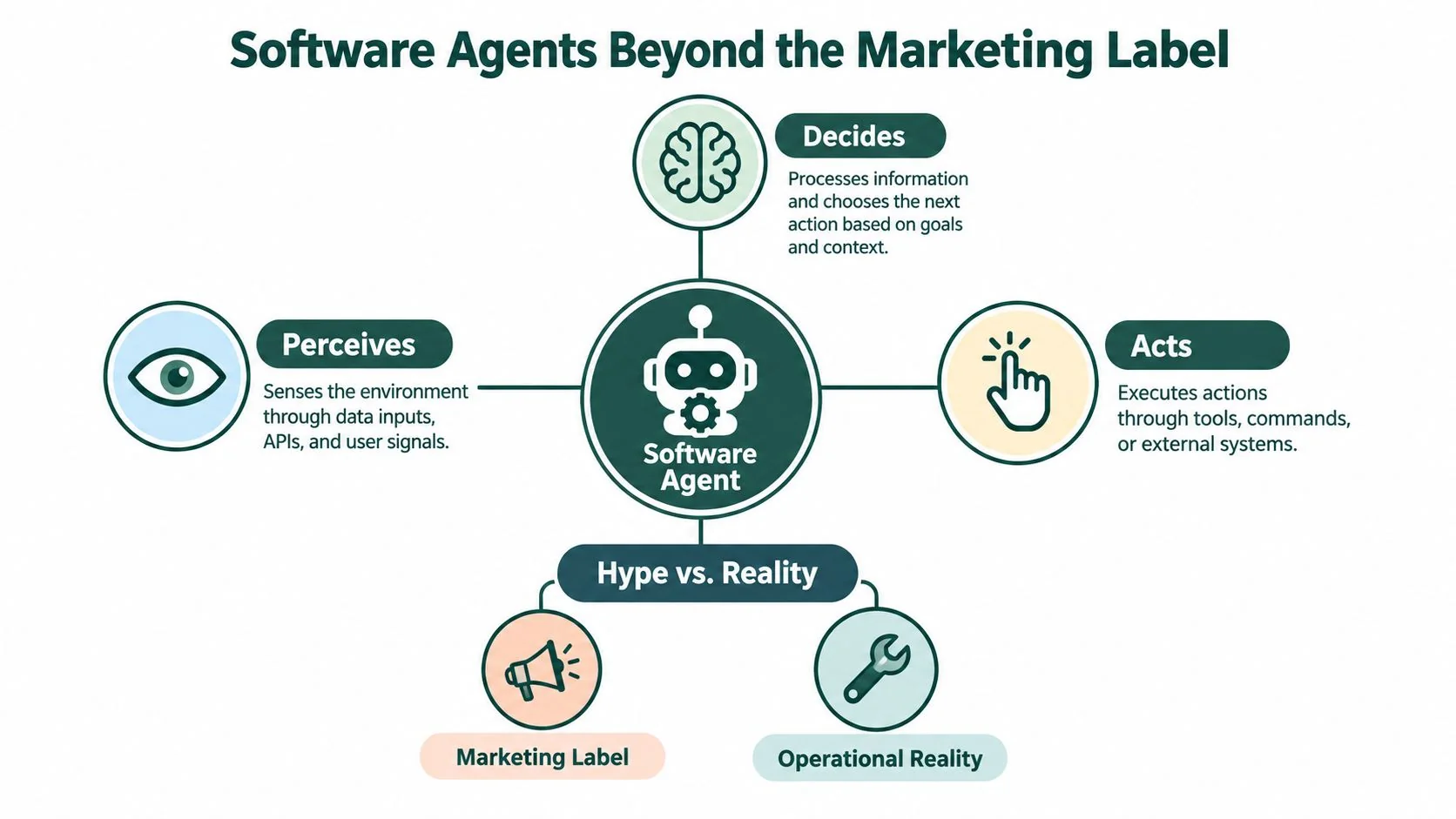
A software agent perceives conditions through inputs or sensors, evaluates the current state against an objective, and acts through software interfaces or physical actuators. The OECD description of autonomous decision-making toward complex goals captures the center of the category, while modern definitions add autonomy, perception, persistence, adaptation, and goal-directed behavior.
That last set matters in a proposal. A passive component returns a response to a command. An agent selects and executes actions, monitors the result, and continues. Once it can write to a CRM, change a repository, or spend media budget, you’ve sold an operating system for decisions, not a feature.
Why Misclassification Costs Agencies Money
Call a deterministic integration an agent and the client expects judgment you didn’t build. Call an adaptive system ordinary automation and you omit the controls it needs. Both errors damage margin. The first inflates the estimate dispute later. The second creates an incident with no clear owner.
Adoption data shows why skepticism is justified. McKinsey’s 2025 survey of 1,993 respondents across 105 countries found 39% of organizations experimenting with agents but only 23% scaling an agentic system, and no individual business function exceeded 10% reporting scaled deployment. Experimentation is cheap. Production ownership isn’t.
More autonomous is not more advanced. For a repeatable process, constrained automation often gives a smaller error surface, lower cost, and a cleaner audit trail.
Niche authority starts there. An agency that can say no to an agent, with a technical reason, sounds different from every competitor selling AI implementation. A bounded example helps in sales conversations. An approval-gated ads agent is easier to discuss than open-ended autonomy because the approval boundary makes the risk conversation concrete. You can price the gate, the log, and the exception path. You can’t price vague intelligence.
The category also isn’t new. That history helps you resist fashion claims, because the design vocabulary, independent operation, reactivity, proactiveness, and communication, predates current language models by decades. Your pipeline advantage comes from translating that older discipline into a specific vertical problem buyers already recognize.
Understanding the Main Software Agent Types
Agent type labels describe different axes, not five separate products. Treat them as scoping language. A system can be autonomous, mobile, and part of a multi-agent design at the same time, and your estimate changes with each axis you accept.
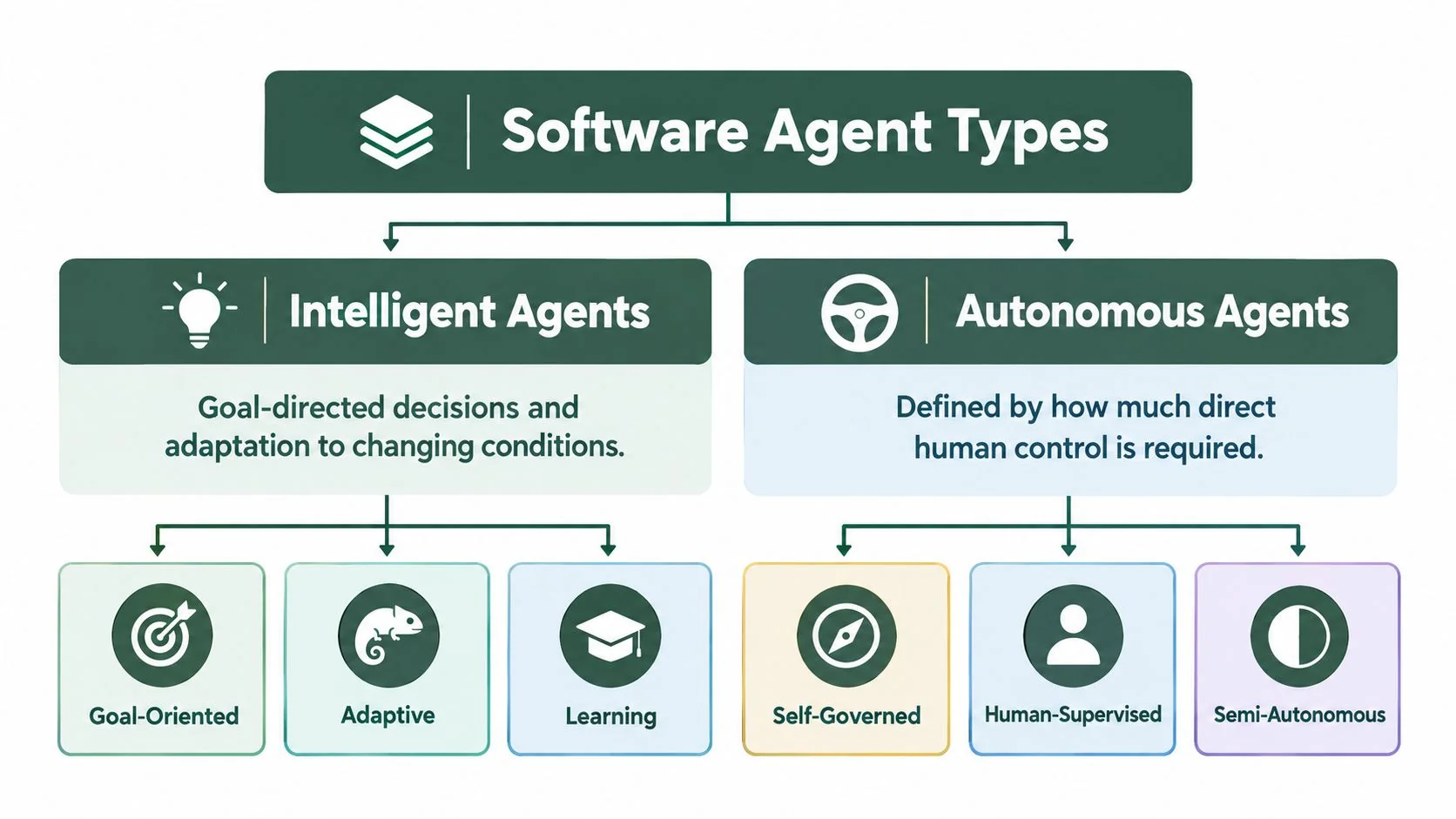
Intelligent agents describe behavior. They pursue a goal, react to change, and adapt the next action. Autonomous agents describe supervision. The question is how much direct human control remains, not whether a model sounds capable in a demo.
Multi-agent systems describe coordination. Work is distributed among agents that cooperate, compete, or hand tasks to each other. Virtual assistants describe the interface and setting, usually a user-facing service. Mobile agents describe portability across environments or devices while preserving a goal.
The History Behind the Labels
The field became recognizable in the 1990s, with roots in artificial intelligence, distributed systems, and cybernetics. Academic histories tracing software agent development strands point to distributed AI work around 1977 and a stronger focus on autonomous software entities around 1990. A later review counted 463 Google Scholar results between 1990 and 1994, after only a handful of references in the prior two decades.
The milestones gave agencies language still used in architecture reviews. AGENT0 appeared in 1991, Touring Machine in 1992, InteRRaP in 1993, and AgentSpeak in 1998. Wooldridge and Jennings framed agents through autonomy, social ability, reactivity, and proactiveness. The belief-desire-intention model added a structured way to represent beliefs, goals, and planned actions.
The short video below gives a useful orientation before you map those labels to a client requirement.
For niche positioning, force every label to name a technical requirement. If a client asks for a multi-agent system, ask what coordination problem requires more than one owner. If they ask for an autonomous assistant, ask which actions run without approval. Agencies that ask those questions in discovery protect margin and sound senior before any outbound sequence mentions a capability.
Choosing Agents Over Familiar Alternatives
Start every estimate with one question. Does the task need the model to direct its own process, or does it need a fixed path executed well? Anthropic’s December 2024 guidance on workflows versus agents draws the line cleanly. A workflow follows predefined code paths, while an agent lets the language model dynamically direct process and tool use.
That distinction exposes a common sales problem. Many projects marketed as agents are deterministic integrations with a language model inserted into one step. The client pays for autonomy, the agency delivers orchestration, and both sides argue later about reliability. Name the architecture in the proposal and the dispute shrinks.
Software Agent Decision Matrix
| System | How It Decides | Typical State | Tool Access | Best Fit | Main Risk |
|---|---|---|---|---|---|
| Chatbot | Generates a response from input and context | Conversation history | Optional retrieval, limited writes | Answers, drafting, guided intake | Confident but wrong output with no action record |
| Script | Follows explicit instructions in order | Local variables, job status | Fixed commands or APIs | Backups, file transforms, repeatable jobs | Breaks when inputs fall outside expected cases |
| Workflow | Branches through predefined paths | Step state and business record | Approved tools at defined steps | Invoice extraction, ticket routing | Rigid when interpretation varies between cases |
| Microservice | Executes a bounded service contract | Service data behind an interface | Exposes APIs for other systems | Pricing, eligibility, payment capability | Mistaking a service boundary for decision-making |
| Agent | Selects permitted actions from goal and observations | Task state, memory, action history | Chooses among tools within permissions | Research, ambiguous resolution, coding tasks | Compounding errors and unclear accountability |
Invoice extraction usually belongs in a workflow. Retrieve the document, extract fields, validate totals, route exceptions. Support ticket routing often belongs there too. Don’t add model-directed planning where a decision table audits better.
Multi-step research is different. The system may need to search, inspect sources, revise the query, and decide when evidence is sufficient. Readers who want the component view can compare that pattern in the multi-step agent architecture explained breakdown from AuricIDE, then test whether their own use case needs that much discretion.
There’s also a commercial comparison your finance lead should make. Before promising custom autonomy, check what agencies pay for UiPath and other platform routes against build and maintenance cost. Sometimes the right recommendation is a workflow platform, a narrower integration, or no agent at all.
For pipeline, this qualification test is content buyers can use before a call. Publish the matrix for one vertical, with named processes and approval points. Prospects who self-diagnose arrive with a cleaner scope, and your agency owns the decision language competitors keep blurring.
How the Software Agent Architecture Works
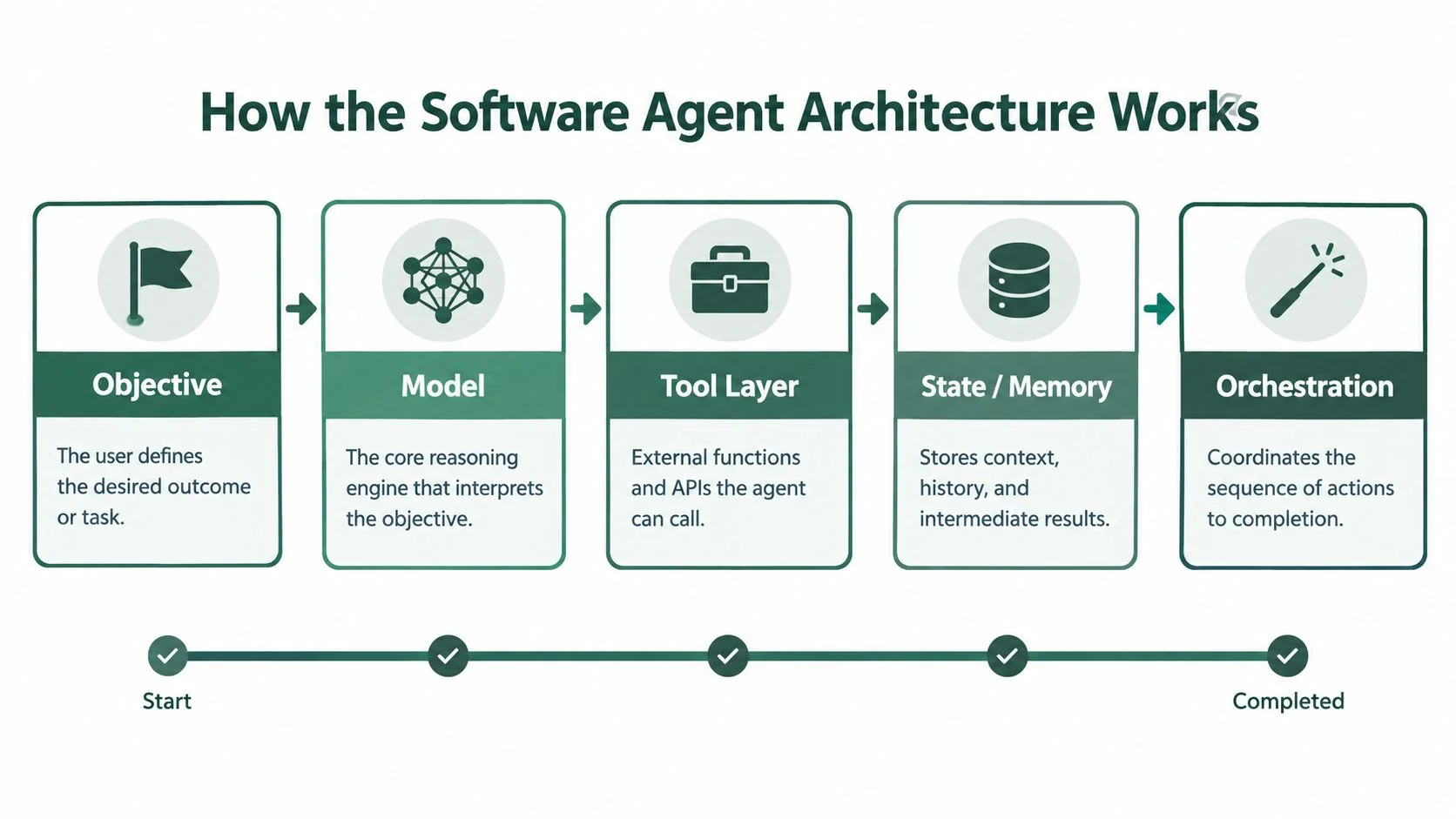
A production run starts with an objective, not a prompt. The agent observes the environment, plans the next action, calls a tool, inspects the result, updates state, and either continues, retries, escalates, or stops. Agent quality depends on that full control loop, not only on the model.
The ReAct pattern makes the loop explicit by interleaving reasoning with actions such as API calls, database queries, retrieval, code execution, or browser interaction. Google Research’s ReAct evaluation results reported gains of 34 percentage points on ALFWorld and 10 points on WebShop over earlier baselines. On WebShop, one-shot ReAct reached 40.0% success versus 29.1% for imitation learning and 28.7% for imitation learning plus reinforcement learning.
Those results support a narrower conclusion than vendors usually draw. External observations correct stale or incomplete model knowledge, and intermediate reasoning helps maintain a plan. They don’t remove the need for tool schemas, permissions, retry logic, state persistence, observation quality, and termination criteria. Your SOW should list each one as an engineering deliverable.
The Components You Are Actually Selling
- Model: Interprets the goal, current state, and observations, then selects the next action within policy.
- Tools: Callable functions that retrieve data, execute tasks, or change external systems, each with documented permissions.
- State and Memory: The task context the system retains, limited to what the job needs and retained only as long as policy allows.
- Orchestration: Step control, handoffs, branching, retries, and the rule that decides the task is complete.
- Guardrails and Tracing: Approval checks, safety limits, and a record of generations, calls, and decisions.
OpenAI’s agent-building documentation on composable primitives frames tools as functions for retrieval, task execution, and external interaction, and describes orchestration as managing steps, tool use, handoffs, guardrails, and context. That gives your delivery team a checklist. Document every callable function. Attach a permission. Name the component that owns the final response.
Multi-agent design needs the same discipline. OpenAI’s orchestration guidance on handoffs and agents as tools separates two patterns. A handoff transfers control to a specialist. An agent as a tool keeps the manager in control while it calls a bounded specialist.
Use a handoff when a billing specialist should own the rest of a support branch. Use agent as tool when a manager must produce one controlled answer after consulting a pricing checker or policy retriever. Add a specialist only for capability isolation, policy isolation, prompt clarity, or trace legibility. If none applies, build one agent or a workflow.
Tracing turns that design into an acceptance test. OpenAI Agents SDK tracing span documentation records generations, tool calls, handoffs, guardrails, and custom events as structured trace spans. For an agency, that’s a sellable difference. A client can see who decided, what ran, and where approval occurred. That evidence builds niche authority faster than a generic autonomy claim, especially in regulated work where buyers ask for proof during procurement.
Where Agencies Can Apply Agentic Systems
Judge use cases by variability, reversibility, data sensitivity, and the value of adaptation. If the action sequence is known and errors are expensive, fixed orchestration wins. If interpretation changes between cases and the system must inspect results before choosing the next step, an agent earns consideration.
Strong Candidates and Weak Candidates
Outreach research and personalization can fit when the agent gathers account evidence, checks fit, and drafts a message for human review. The variability is real, the output is reviewable, and sending can stay behind approval. Customer support resolution is stronger when the agent must read account state, policy, and prior actions before deciding whether to answer, refund within a limit, or escalate.
Monitoring and exception handling also fit bounded autonomy. An agent can inspect signals, open an incident, gather logs, and suggest a remediation path. It shouldn’t restart production infrastructure or change access controls without a named approver.
Software engineering shows both the promise and the limit. SWE-bench repository task details and SWE-Bench Pro expansion describe 2,294 issues from 12 popular Python projects, then a broader set of 1,865 problems from 41 active repositories and 123 programming languages. Long-horizon, multi-file tasks are materially harder than simple algorithmic problems.
Selection rule: Fund agent discretion only where the next correct action depends on what the system finds. Fund a workflow where you can write the path in advance.
That result has a direct delivery implication. A coding agent must interpret an ambiguous issue, locate code, preserve repository invariants, edit files, run tests, diagnose failures, and iterate. Each step can introduce an error. Sandboxed execution, least-privilege credentials, deterministic test gates, patch review, rollback, and human approval are the product, not extras.
Invoice extraction and predictable ticket routing remain weak candidates unless interpretation varies materially between cases. Open-ended research, ambiguous support resolution, and repository tasks justify more discretion because the path can’t be fully specified in advance.
For niche authority, publish the evaluation set, not just the use case list. Show the tasks, tool boundaries, failure categories, and approval thresholds for claims operations, developer support, or another vertical you want to own. Buyers remember the agency that shows its test. That asset also gives outbound a specific reason to contact accounts with the same process, instead of sending another broad AI services pitch.
Controlling Security Ethics and Accountability
An agent with write access can change CRM records, customer files, code, infrastructure, or payment state. Control design is therefore part of the definition you sell. Human oversight doesn’t disappear. It moves from performing every step to supervising objectives, permissions, exceptions, and high-impact decisions.
Deployment evidence supports treating this as an operating problem. PwC’s 2025 survey of 308 US executives identified connecting agents across applications and workflows, organizational change, and employee adoption among the leading challenges. Those are integration and ownership problems, not model problems, and your agency gets paid to solve them.
Cloudera’s numbers in the same evidence set sharpen the point. Data privacy was cited by 53% of respondents as a barrier, followed by legacy integration at 40% and implementation cost at 39%. A proposal that leads with model choice and buries those three issues will not survive a serious CIO review.
Minimum Controls for Client Work
- Least-Privilege Access: Give each tool the narrowest credential that completes the task, with separate permissions for read and write actions.
- Sandboxing and Approval: Run code and high-impact actions in constrained environments, with approval thresholds tied to reversibility and value at risk.
- Audit and Rollback: Retain action logs, tool results, and decision traces, and define how a bad change gets reversed before launch.
- Evaluation Sets: Test against real tasks, stale data, invalid tool arguments, policy conflicts, and legacy system failures before expanding access.
- Named Ownership: Assign one human owner for objectives, exceptions, incident response, and final accountability.
Ethics belongs in the same design review. Who can see customer data? Which actions can be reversed? How does bias enter planning or tool selection? Who answers when an automated outcome harms a customer? If your team builds coding agents, the secure agentic coding practices guidance from DevArmor is a practical reference for turning those questions into delivery checks.
This is a positioning advantage, not compliance overhead. Agencies competing for finance, healthcare, insurance, or enterprise operations work can win by showing the accountability architecture in the first technical workshop. Competitors bring a demo. You bring permissions, traces, evaluation cases, and an owner. That difference fills pipeline with buyers who have budget because they also have risk.
Building an Agency Adoption Framework
Start with one costly, bounded process that has observable inputs and outputs. Don’t start with a platform, a multi-agent roadmap, or a CEO’s request to add AI. A narrow process gives you a baseline, a failure budget, and a result a client sponsor can defend internally.
A Staged Path From Pilot to Scale
First, classify the work. If the steps and branches are predictable, build a workflow and stop. If the order or number of actions can’t be specified in advance, document the tools, permissions, data sources, failure modes, and approval thresholds before anyone writes agent code.
Second, pilot against real tasks. Build an evaluation set from completed cases, including messy inputs and known exceptions. Instrument every action and tool result. Compare quality, cost, incident rate, and human review time against the current process, then expand access only where the agent beats the baseline without hiding review work.
Third, write proposal language that separates model quality from system reliability. State who owns exceptions, which actions need approval, what gets logged, and how rollback works. That language sells a vendor who has already located the risk, not certainty.
For market context during positioning, scan the AI development companies list and note how many competitors describe identical services. Open with a vertical reference architecture, with a risk model, evaluation cases, and one implemented process that prospects can inspect, rather than another agent development page.
Publish that asset where buyers validate vendors, then use it in outbound to accounts running the same workflow. The agencies that own a niche will be the ones prospects cite for a specific operating decision, such as claims intake with approval gates or developer support with traceable handoffs. That’s a stronger pipeline position than attaching agent language to ordinary delivery work and hoping the market treats it as specialization.
If your agency wants to turn that kind of specific agent judgment into recognized authority in one defensible niche, request a free positioning scan from 100Signals. We’ll map where your expertise is visible in search, AI assistants, and LinkedIn, then show you how to turn that recognition into qualified pipeline before outreach begins.